How to Find a Side Hustle Idea (When Nothing Feels Obvious)
If you've ever sat down with a blank page, written "side hustle ideas" at the top, and waited for something brilliant to appear, you already know how unhelpful a blank page can be.
It asks you to come up with a finished business before you've gathered anything to build one from.
So when nothing feels obvious, start somewhere smaller.
Look for the pieces that are already there: things you know, skills you've picked up, problems you've solved, and ways people already rely on you.
A realistic side hustle often starts with noticing those pieces before trying to name the business.
Start with evidence from your own life
"What side hustle should I start?" sounds like a reasonable question.
It's also enormous.
Suddenly you're trying to figure out what you could sell, whether anyone would buy it, how much you could charge, whether you'd enjoy it, and whether it could become a real business.
That's a lot to ask from one brainstorming session.
Shrink the question. Start by looking for evidence of useful things that already exist.
Maybe coworkers regularly ask you to fix their spreadsheets. Maybe you're the person friends send their resumés to before applying for jobs. Maybe you can walk into a cluttered room and immediately see how to organize it. Maybe you spent months figuring out a problem for your own family and now know far more about it than you ever expected to.
Those aren't complete business ideas yet. They're pieces you can work with.
Notice what people already rely on you for
Think about the moments when someone has said some version of: "Can you help me with this?" "How did you do that?" "Can you look this over?" "You'd know how to fix this."
One request doesn't reveal a business opportunity. But patterns in the kinds of things people ask you about can help you notice abilities you've stopped paying attention to because they feel ordinary.
Suppose friends regularly ask you to make invitations, edit photos, or help them create things in Canva. You don't have to jump immediately to "I should become a graphic designer." The useful observation is simpler: people already trust me for basic visual and creative help.
Now there's something to explore.
Could that skill help local businesses create simple graphics? Could you design invitations? Could you help someone clean up a presentation?
The finished idea can come later. First, notice the pattern.
Pay attention to what feels easy now
Some useful skills are hard to recognize precisely because you already know how to do them. You forget what it took to learn.
Maybe you know how to organize a complicated schedule, plan an event without missing the important details, use software other people avoid, photograph products well, prepare freezer meals efficiently, manage invoices and paperwork, edit writing clearly, grow a vegetable garden, coordinate travel, or create systems that keep a household or office running.
The fact that something feels easy to you now doesn't mean it is easy for everyone.
A task that feels simple to you may still be something another person would rather pay to have done.
Look at problems you understand well
A useful skill isn't the only place an idea can begin. Sometimes what you understand matters just as much.
Maybe you've worked with tradespeople for years and understand how quickly their paperwork piles up. Maybe you've organized enough children's birthday parties to know exactly which pieces overwhelm parents. Maybe you've managed community events and know the details a first-time organizer doesn't even know to think about. Maybe you've spent years in a particular industry and hear the same customer frustrations over and over again.
That experience gives you a point of view.
Now you can start asking:
Is there something I know how to make easier here?
That's often more productive than trying to invent a business that sounds impressive.
Don't dismiss ideas because they sound ordinary
This is one of the easiest ways to overlook something workable.
Bookkeeping sounds ordinary. Dog walking sounds ordinary. Editing resumés sounds ordinary. Cleaning homes sounds ordinary. Creating simple graphics for local businesses sounds ordinary.
Good.
People don't need every side hustle to be groundbreaking. They need things done, fixed, organized, created, explained, or made easier.
An idea can feel painfully obvious to you and still solve a real problem for somebody else.
So when a possibility comes up, don't immediately judge it by how clever it sounds.
Ask:
Could I see a real person having a reason to want this?
That question is much more useful.
Collect a few possibilities before choosing
This is where a new kind of pressure can sneak in.
One possible idea finally appears and suddenly you're asking:
Is this the one?
Write it down and keep looking. Choosing comes after you've gathered enough to compare.
Your organizational skills might point toward home organizing, administrative support, or move-preparation help. Your Canva experience might point toward basic graphics for local businesses, invitations, or presentation design. Your gardening knowledge might point toward garden setup, seasonal maintenance, or beginner workshops.
At this stage, you're looking for possibilities worth exploring.
Three solid possibilities give you something useful to compare without leaving you buried under 50 unrelated ideas.
Finding an idea and proving an idea are different jobs
This distinction matters.
When you're trying to discover what your side hustle could be, you do not need to answer every future business question at the same time.
A possibility does not yet need a business name, a website, branding, a detailed offer, final pricing, a social-media strategy, a launch plan, or proof that it will succeed.
Those questions belong to later stages.
Right now you're trying to answer:
What could I realistically explore?
That's enough.
If you demand proof of success from every possibility before you're even willing to write it down, very few ideas will survive.
Finding possibilities is one job. Choosing among them is another. Shaping the winner into something people can buy comes after that.
Keeping those jobs separate makes the beginning much easier to work through.
Look for connections, not finished answers
Sometimes the pieces are obvious individually but harder to connect.
You know you're organized. You understand busy parents. You're good at creating routines.
Those three things sitting separately on a page may not look like a business. Put them together and you start seeing possibilities around household organization, routine planning, or practical support.
Or maybe you know Canva, understand the needs of local business owners, and could help them create simple graphics.
Now there's a direction.
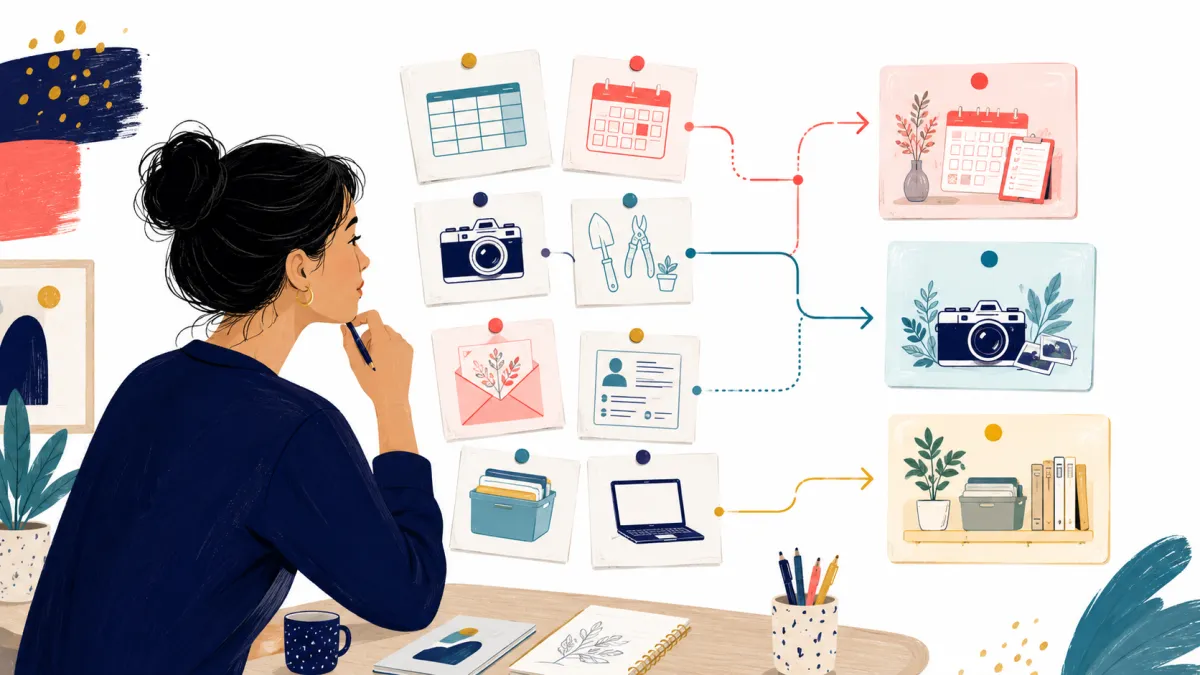
This is why starting with pieces works. One answer by itself may not look important. Several answers beside one another start forming patterns.
The workbook's Idea Builder is designed around exactly this kind of connection — something from your own answers, who might need it, what you could help with, and then a direction worth exploring.
If you're still thinking, "I know there's something here…"
That's exactly what the 12 Questions to Find Your Side-Hustle Idea workbook is for.
It takes you through the skills, experience, interests, problems, and useful knowledge you already have, then helps you connect those pieces and narrow what you uncover to three realistic side-hustle possibilities worth exploring.
It also includes an Idea Builder for spotting connections and an AI Connector that works from your own answers rather than handing you another generic list of popular side hustles.
Find My 3 Side-Hustle Possibilities →
Already have a few ideas?
Then you may be finished with the idea-finding part.
Read How to Choose Between Two Business Ideas next.
Finding a side hustle idea doesn't have to begin with a flash of inspiration.
Start with the pieces. What you could build becomes much easier to see once there's something real to connect.