How to Turn a Rough Idea Into a First Offer
An idea and an offer are not the same thing.
"I could help small businesses with social media" is an idea.
"I'll create and schedule a month of Instagram content for independent coffee shops that want to stay visible without spending hours making posts themselves. It will cost $200 for the month" is an offer.
The difference is specificity. An idea gives you a direction. An offer gives someone something clear enough to understand, react to, and buy.
The four things a first offer needs
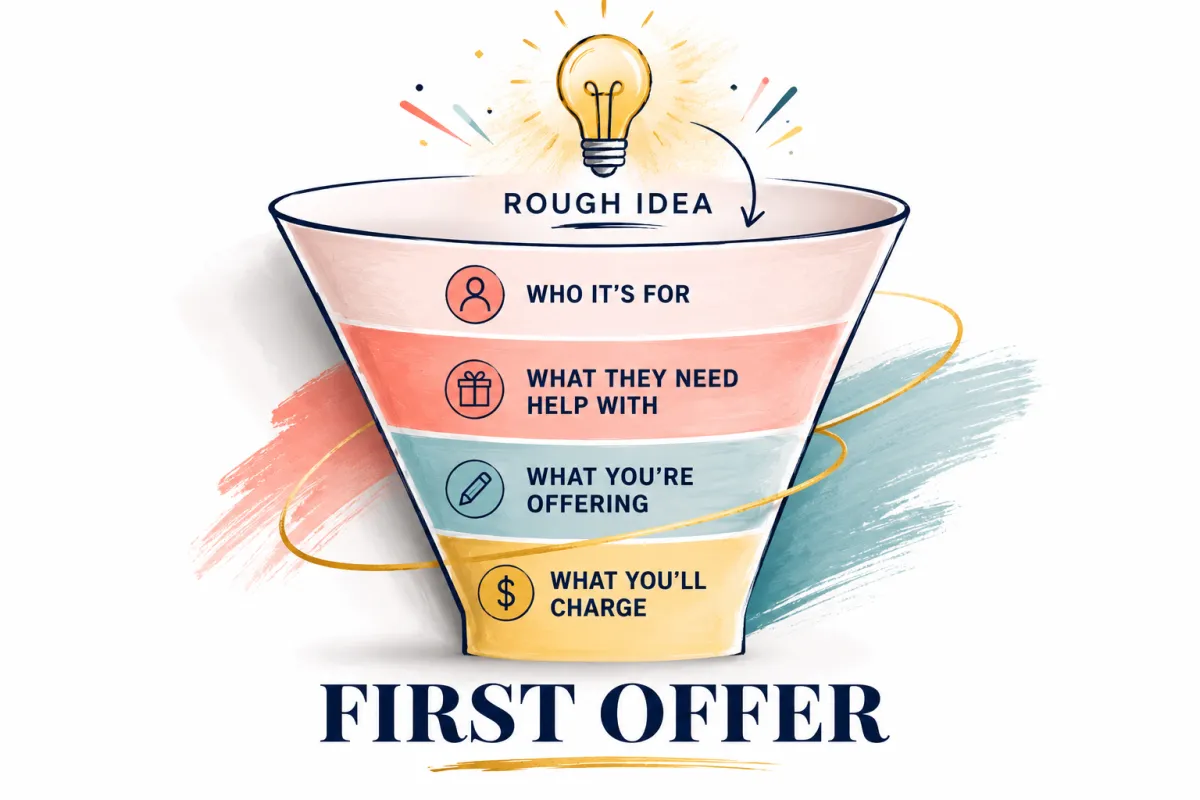
For a first offer, you need four basic things:
Who it's for. Choose a specific kind of person in a situation you understand. "Small businesses" is broad. "Independent coffee shops that struggle to post consistently on Instagram" gives you something much easier to build around.
What they need help with. Name the problem, task, or result the offer is meant to address. Your customer isn't buying "social media." She may be buying a month of consistent posts without having to create them herself.
What you're actually offering. Make it concrete. Instead of "I'll help with your social media," try "I'll plan, write, and schedule 12 Instagram posts for the month." Now the offer is tangible.
What you'll charge. Your first price doesn't have to be your forever price. It just needs to be a real number you're willing to ask for.
If you can't answer all four yet, that doesn't mean the idea is wrong. It means it still needs shaping.
Two mistakes that keep an idea stuck
Making it too big too soon. A full service suite, three packages, a complete business model, a six-month program... all of that can come later. Your first offer has a smaller job: be clear enough to test.
Waiting for it to feel finished. This is where good ideas get trapped. You keep adjusting the wording, adding features, comparing competitors, and trying to make the offer feel certain before anyone has seen it. At some point, the next useful information has to come from outside your own head.
Your first offer is a test, not a verdict
Your first offer doesn't need to prove you chose the perfect business. It doesn't need to represent everything your business will eventually become. It needs to give you something real to learn from:
Can people understand it?
Do they care about the problem?
What questions do they ask?
Will anyone pay for this version?
That's the value of a first offer. It turns a vague idea into something another person can respond to.
A great way to shape your rough idea
Answer four questions:
Who is this for?
What do they need help with?
What am I actually giving them?
What am I asking them to pay?
Then combine them into a rough offer. For example:
I'll create and schedule 12 Instagram posts for independent coffee shops that want to stay visible without spending hours creating content themselves. The first-month package is $200.
It may change later. That's fine. The point is to get it clear enough to stop guessing and start learning.
Less circling. More finding out.
Some questions can't be answered by thinking longer.
Thinking helps you compare options and make better decisions. But once the offer is clear enough, the next answer comes from putting it in front of a real person. You'll learn more from one real yes or no than from another week of refining it alone.
That's the Defy Doubt move: make the next move concrete enough to teach you something.
If you want the full structured version
The First Offer Workshop takes you through the complete process of choosing what deserves a fair test, shaping it into a clear offer, and setting a starting price.
If the idea itself still isn't chosen yet
If you're still deciding between a few possibilities, choosing comes first. Read: How to Choose Between Two Business Ideas.
Not sure which step is actually yours?
Where you start depends on where you are. The free two-minute quiz shows you exactly what your next move is. Whether you're still discovering possibilities, choosing between them, shaping an offer, or ready to start building.
Find My Starting Point — Free 2-Minute Side-Hustle Quiz
A rough idea becomes a first offer when it's specific enough for someone else to respond to. That's enough to start finding out.