What's Left for Me?
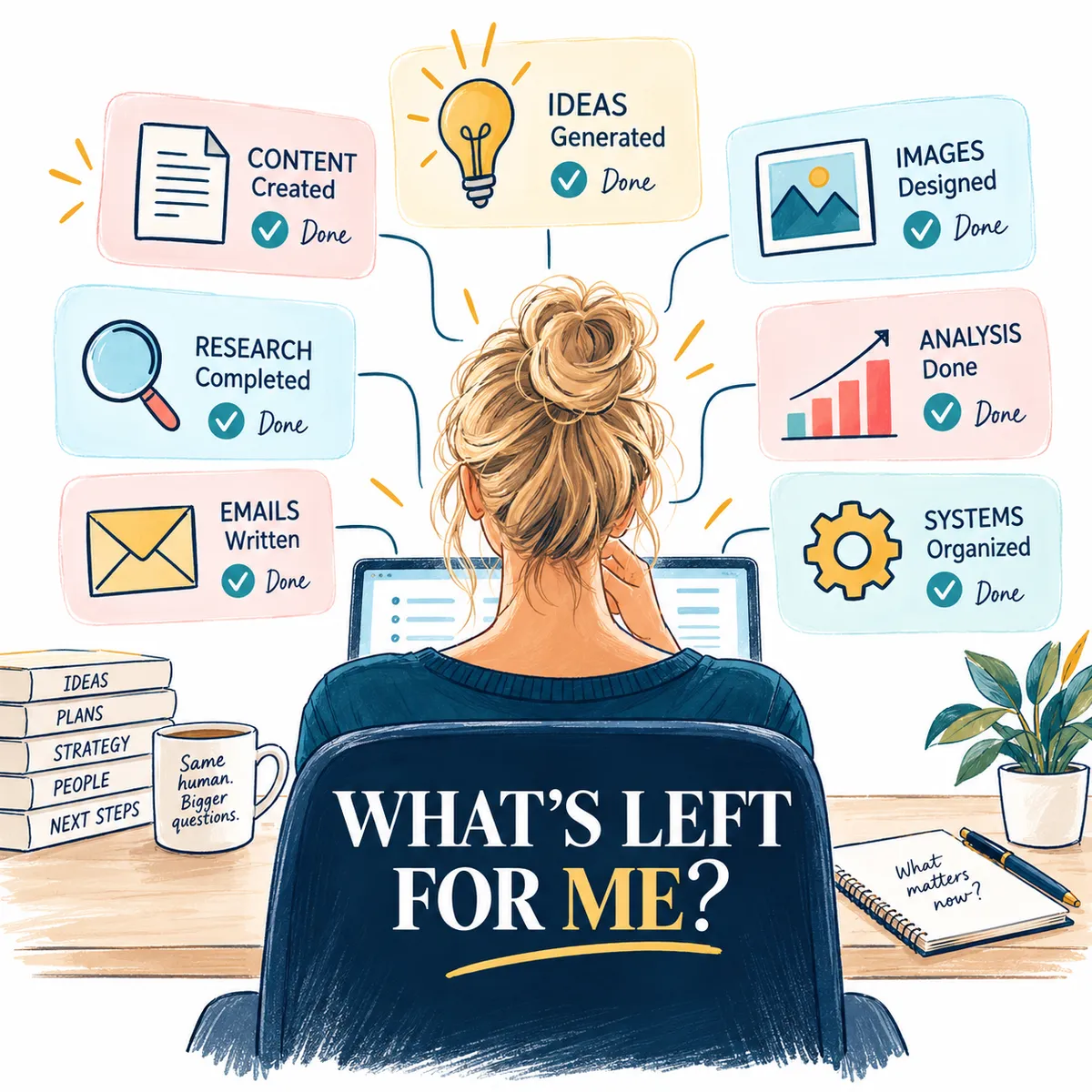
The more AI does for me, the more I'm questioning what my actual job is.
I use AI a lot. Research, editing, brainstorming, images, organizing my mess of ideas, you name it. I love it.
And lately I've started connecting it to other things I use, which has changed something. Instead of asking ChatGPT how to do something and then going off and doing it myself, I'm just asking it to do it for me.
The other day I was working in a spreadsheet. Just three months ago, if I wanted cells highlighted based on something selected from a dropdown menu, I'd ask how to set that up, get the instructions, and then do it myself. And I thought that was pretty sweet.
Now… I basically just say, do this. And it does. Great. One less thing for me to do. Even though I love learning how to do all that stuff, this saved me so much time.
However, I keep having these little moments where I think — okay, so if AI is doing more and more of what I was great at, then what's left for me?
Not in a dramatic, robots-are-coming-for-us kind of way. I'm genuinely curious.
The FOMO is real
Because I keep hearing that you need to learn AI right now, especially if you work online, and I agree with that. There's a definite feeling of needing to keep up. Blogs, printables, digital products, graphics, and loads of other things. Things that took hours can now be made in minutes, and sometimes they're pretty decent.
There's FOMO in that. At least there is for me.
If all of this can be created so quickly now, am I behind if I'm not using it? Should I be building something around it? And if everyone else can make the same things this quickly, are some of the skills I've spent years learning becoming less valuable?
And if you're trying to start something right now, that can make an already messy decision feel even harder.
I don't know. And that's probably the part I'm most interested in.
What happened when I put my own work back into ChatGPT
About a year ago, I made an e-book called Sprouting Resilience. I built it in Canva and did all the graphics, cropping, cutting, and fiddly little things myself. It took a lot of work and a lot of time.
Recently, I started looking at it again because I wondered whether there might still be something I could do with it. So I put the whole thing into ChatGPT and asked it to scrutinize it. Find the holes and tell me where my thinking wasn't strong enough.
And it did.
Some of the feedback was useful enough that I changed things. That doesn't bother me. I don't look at it and think AI somehow took something away from what I created. I think it made it better.
I don't have millions of books, articles, examples, and pieces of information sitting in my head that I can compare my work against in seconds. Why wouldn't I use something that can help me do that?
But I also don't just take whatever it gives me and call it finished. I go through everything. I'll edit it, I'll reframe it, and tell it when something doesn't sound like me. I ask for research. I challenge what it tells me, and sometimes I ask it to challenge me. The more I give it, the better it gets.
Which brings me right back to the same question.
When AI starts doing more than helping
I've been looking at software recently that takes this much further. The promise isn't just that it will help you make a product. It can potentially find people to work with, research them, identify gaps in what they're offering, write the outreach, send it, see who responds, help create a product for that audience, and keep going from there.
And part of me thinks that sounds incredible! Another part of me thinks, if it really does all of that, why does it need me — or anyone, for that matter?
That's not me saying it doesn't work. In some ways, the fact that I think it could work is what makes the question more interesting.
If ten people have access to the same system, what makes one of them better at this than the others? If we can all create the product, write the email, and find the opportunity, where does the difference come from?
Maybe it's knowing whether the product is actually good, or knowing what information to give the system in the first place. Maybe it's catching something that's technically correct but doesn't feel right. Maybe it's understanding the person on the other end well enough to know that what the system says they need isn't actually what they need. Maybe it's just discipline.
Or maybe I'm giving us humans too much credit, and AI will get really good at those things too.
Where I've landed, for now
I don't know yet. I don't think any of us need to pretend we do. What I don't want to do is make decisions because everyone else seems to be running in one direction, and I'm scared I'll be left behind if I don't follow.
That's different from seeing what's changing and deciding I want to learn how to use it. I absolutely want to learn it.
I want AI doing more in the background. I want it connecting programs for me. I want it keeping track of things I don't need to keep in my head. I want it looking at analytics and noticing things I might miss. If something takes me three hours and AI can do it properly in three minutes, I'm not going to spend three hours doing it just so I can say a human did it.
That's ridiculous.
But I'm also starting to wonder whether I've been looking at the wrong part of my own work.
Maybe typing the words was never the valuable part. Maybe manually building the spreadsheet wasn't either. Maybe spending hours cropping images didn't make the finished product more valuable just because it took me longer.
Perhaps the thing I need to get clearer about isn't what AI can do. It's what I can do with it that actually matters to someone else.
I don't have a neat answer to that yet.
I don't think I need one.
Still figuring out where you stand?
If any of this hit close to home, if you're not sure whether you're using AI to move your own idea forward, or just using it to feel like you're keeping up, the free Side-Hustle Quiz can help you find your actual starting point.